Fresh Egg Tagliatelle Recipe: Homemade Italian Pasta | Mama Florence Cooking School
Course: Pasta / Main Course - Cuisine: Italian; Serves: 4. Prep: approx. 25 min, Rest: 30 min + 10 min after rolling, Cook: 2–3 min. Total: approx. 1 hr 10 min.
Tagliatelle is a long, flat ribbon pasta traditionally associated with northern and central Italian cooking.
Its name comes from tagliare, the Italian verb meaning “to cut,” which makes perfect sense when you see how the pasta is made: a thin sheet of fresh egg dough is rolled out and cut into long strips. Our version is cut to approximately 0.5 cm wide, giving the finished pasta enough surface area to hold a sauce without becoming heavy. Unlike dried pasta made primarily from durum wheat and water, this recipe uses fresh eggs together with a blend of all-purpose flour and semola.
A Classic Italian Pasta
Fresh tagliatelle begins with just a few ingredients, but the transformation is part of what makes handmade pasta so satisfying.
At Mama Florence Cooking School, this dough combines all-purpose flour and semola with eggs, creating a pasta that rolls thinly while still keeping enough structure for those long, ribbon-like strands. The dough is kneaded until smooth, given time to rest, then rolled to about 1 mm thick before being cut into tagliatelle. Once the pasta reaches boiling water, the final step is remarkably quick: fresh tagliatelle needs only a few minutes to cook. Serve it with something simple, like fresh basil pesto, or choose a richer sauce that can cling to the broad ribbons.
How to Make Fresh Tagliatelle Pasta
Ingredients
• 200 g all-purpose flour • 200 g semola flour • 4 eggs
Mama’s Secret: Pay attention to the dough rather than treating the flour measurement as an absolute rule. If the dough feels too soft or sticky as you knead, add a little more flour. If it feels unusually stiff, add a few drops of warm water. Eggs and flour can behave slightly differently from one batch to another, so the texture of the dough is your best guide.
1. Make the Fresh Pasta Dough
Place the flours in a bowl or mound them directly onto a clean work surface.
Create a well in the center.
Break the eggs into the well one at a time, then use a fork to beat them gently while gradually drawing flour in from the edges.
Continue incorporating the flour until the mixture becomes too thick to work comfortably with the fork.
Begin kneading by hand and continue until the dough becomes smooth and homogeneous.
If the dough feels too soft or sticky, work in a little additional flour. If it feels too stiff, add a few drops of warm water.
2. Let the Pasta Dough Rest
Shape the dough into a ball and dust it lightly with flour.
Cover with plastic wrap and leave it to rest at room temperature for 30 minutes.
This resting period makes the dough easier to roll and work with in the next stage.
3. Roll the Tagliatelle Dough
Lightly flour your work surface to prevent sticking.
Roll the dough outward from the center using a rolling pin until the pasta sheet reaches approximately 1 mm thick.
You can also roll the dough with a pasta machine. If the pasta begins to feel sticky as you work, dust it lightly with flour.
4. Let the Pasta Sheet Dry Briefly
If possible, let the rolled pasta sheet rest for around 10 minutes before cutting.
The short drying period makes the surface slightly less tacky and helps the ribbons separate more easily.
5. Cut the Tagliatelle
Using a sharp knife, cut the pasta sheet into strips approximately 0.5 cm wide.
Arrange the finished tagliatelle on a lightly floured tray so the strands do not stick together.
If you have a pasta machine with a tagliatelle attachment, you can also use it to cut the rolled dough into ribbons.
6. Cook the Fresh Tagliatelle
Bring a large pot of salted water to the boil.
Add the fresh tagliatelle and cook for approximately 2–3 minutes.
Drain the pasta, then immediately combine it with your chosen sauce.
Because fresh egg pasta cooks so quickly, have the sauce ready before the tagliatelle goes into the water.
Shop Mama Florence's Pantry
Marcato Atlas 150 Classic Pasta Machin: the recipe works beautifully with a rolling pin, but if you prefer a pasta machine, Mama Florence's Marcato Atlas 150 helps roll fresh egg pasta into the thin, even sheet you need for filled Tortelli. The recipe calls for a final thickness of 1 mm, so keep working gradually and flour the dough if it begins to stick.
How Thick Should Fresh Tagliatelle Be?
For this recipe, roll the pasta dough to approximately 1 mm thick before cutting. The strips themselves should be around 0.5 cm wide. That combination gives the tagliatelle enough delicacy to feel like fresh pasta while still giving the ribbons enough body to carry a sauce.
Can You Make Tagliatelle Without a Pasta Machine?
Absolutely, a pasta machine makes it easier to produce consistently thin sheets, but handmade tagliatelle can be made entirely with a rolling pin and a sharp knife. The important part is rolling the dough evenly to approximately 1 mm thick before cutting it into ribbons. In fact, cutting the pasta by hand is exactly where the name tagliatelle begins to make sense: these are quite literally strips of pasta created by cutting a sheet of dough.
What Sauces Go with Fresh Tagliatelle?
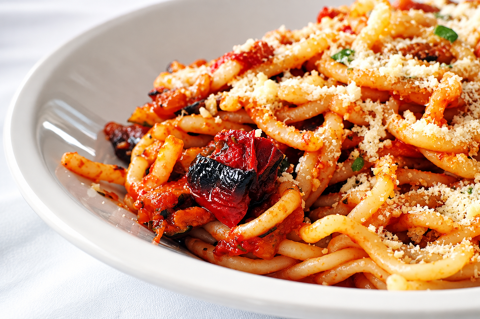
Fresh egg tagliatelle has a silky texture and broad surface that makes it particularly good at carrying sauce. For something fresh and aromatic, toss the ribbons with our Fresh Basil Pesto, allowing the pesto to coat the pasta rather than drown it. Tagliatelle also works beautifully with slow-cooked meat sauces, butter-based sauces, mushrooms, or simply good extra-virgin olive oil and freshly grated Parmigiano. The pasta itself already brings richness from the eggs, so the sauce does not need to compete with it.
Fresh Egg Pasta vs Dried Pasta
Fresh egg pasta and dried pasta are not simply two versions of the same thing. Fresh pasta like this tagliatelle is soft, tender, and cooks in only 2–3 minutes. Eggs contribute richness and give the finished ribbons their characteristic texture. Dried pasta is usually firmer and takes longer to cook, with a texture that lends itself to different sauces and preparations. Neither is automatically better; they simply behave differently in the kitchen.
The Perfect Bite
Fresh tagliatelle should be tender but still have enough structure to hold its shape as you twist it around a fork. The eggs give the pasta richness, while the thin sheet keeps each ribbon delicate rather than heavy. Add a sauce that settles into the folds of the pasta, a little Parmigiano if the dish calls for it, and you have one of those combinations that explains why fresh pasta needs so little decoration.
More Handmade Italian Pasta to Make
Once you have made a basic egg pasta dough, there is an entire world of shapes and fillings to explore.
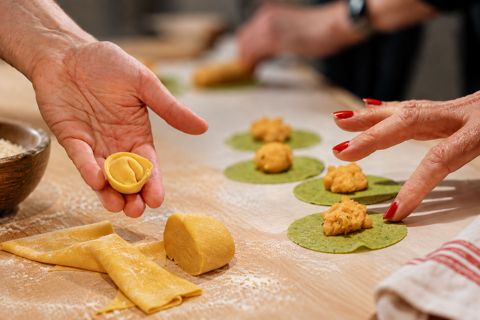
For something filled, try our Tortelli di Patate, where fresh pasta is wrapped around a savory potato filling and finished with butter and sage. Or move in a completely different direction with Pici, Tuscany’s hand-rolled, egg-free pasta. Our guide to Pici all’Aglione explores how that much more rustic dough became one of southern Tuscany’s most recognizable pasta traditions. And if you want a sauce ready for the tagliatelle you have just made, our Fresh Basil Pesto is an easy place to start.
Learn to Make Fresh Pasta with Mama Florence
There is a big difference between reading that pasta dough should feel “smooth” and actually feeling the moment it gets there beneath your hands.
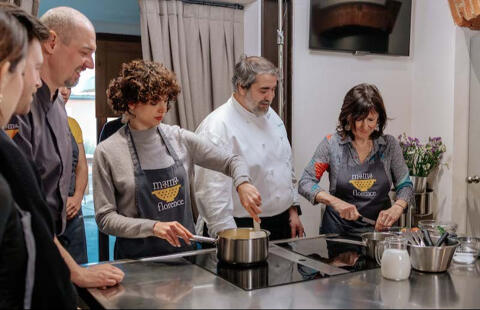
That is why fresh pasta is particularly rewarding to learn in person. In our Pasta Making Cooking Class at Mama Florence Cooking School, you can work through the dough, rolling, shaping, and cooking process alongside one of our chefs and see how small changes in texture make a difference to the finished pasta.
Fresh Tagliatelle FAQ
Q: What is fresh tagliatelle made from? A: This Mama Florence recipe uses 200 g all-purpose flour, 200 g semola flour, and 4 eggs.
Q: How long should fresh pasta dough rest? A: Rest the dough at room temperature for 30 minutes before rolling.
Q: How thin should I roll tagliatelle dough? A: Roll the pasta sheet to approximately 1 mm thick.
Q: How wide should tagliatelle be? A: This recipe cuts the pasta into strips approximately 0.5 cm wide.
Q: How long does fresh tagliatelle take to cook? A: Fresh tagliatelle cooks in boiling salted water for approximately 2–3 minutes.
Q: Do I need a pasta machine to make tagliatelle? A: No. You can roll the pasta with a rolling pin and cut the ribbons by hand with a sharp knife. A pasta machine simply makes it easier to create an even sheet.
Q: Why is my fresh pasta dough sticky? A: The original recipe recommends adding a little more flour if the dough is too soft or sticky. If it becomes too stiff instead, add a few drops of warm water.
Q: What sauce goes well with fresh tagliatelle? A: Its broad ribbons work well with pesto, meat sauces, mushrooms, butter-based sauces, or simple olive oil and Parmigiano. Our Fresh Basil Pesto is a particularly easy pairing.
Disclaimer
Please note that our chefs may adapt recipes according to seasonal ingredient availability and participants’ dietary or allergy requirements. As a result, the ingredients, preparation, or presentation shown in this recipe may vary from what you prepared during your Mama Florence class. In some cases, elements of a dish may also appear as separate recipes. Please reach out to our team if any confusion arises. Thank you - the Mama Florence Family
Reviews
4.912 reviews
Made this on a grey afternoon at home and for ten minutes the kitchen smelled like a holiday.
Markus H.
Cologne, Germany · July 2026
Did it by hand the second time as suggested and yes, it is genuinely different. More work, better texture.
Giacomo N.
Florence, Italy · May 2026
I let it rest longer than suggested because I got distracted, and honestly it rolled even better.
Maria C.
Lisbon, Portugal · May 2026
I halved the quantity for two people and it worked without any change to the timings.
Kate D.
Melbourne, Australia · December 2025
Everything measured and prepared before I started, which is obvious advice that I have ignored for years.
Nathan F.
Perth, Australia · December 2025
A plant based alternative to the one thing I cannot eat worked better than I expected. Slightly different texture at the end.
Christina V.
San Diego, USA · October 2025
I left one ingredient out entirely because of an allergy in the house. Slightly missed, nothing ruined.
Ian P.
Glasgow, UK · April 2025
We cooked it together as a family, which was the actual point, and it happened to taste good too.
Jenna P.
Portland, USA · April 2025
I hosted for the first time in years and chose this because it could be finished ahead. Correct decision.
Federica S.
Bologna, Italy · November 2024
Second time lucky. The first attempt tore because I rushed the resting; the note about covering it properly is not optional, it turns out.
Silvia D.
Padua, Italy · August 2024
I have made this three times now. Each time it gets faster and each time it beats the packet version by a distance.
Claire B.
Ottawa, Canada · August 2024
Served this at a dinner and got asked for the recipe twice before dessert. I sent the link round the next morning and two of them have already made it. It is now somehow associated with me, which I have not really earned.
Potato-filled tortelli from Mugello, finished with butter and sage, tell a story of mountain cooking, regional tradition, and Tuscany’s enduring love of handmad...
Hand-rolled pici, sweet Aglione from the Valdichiana, and a simple tomato sauce come together in one of southern Tuscany’s most distinctive pasta traditions.