Bucatini all’Amatriciana Pasta with Pancetta & Pecorino | Mama Florence Cooking School
Course: First Course / Pasta - Cuisine: Roman, Italian; Serves: 6. Prep: approx. 30 min. Rest: 15 min. Sauce: at least 30 min. Total: approx. 1 hr 15 min, plus pasta cooking.
Bucatini all’Amatriciana: Tomato, Pancetta and Pecorino
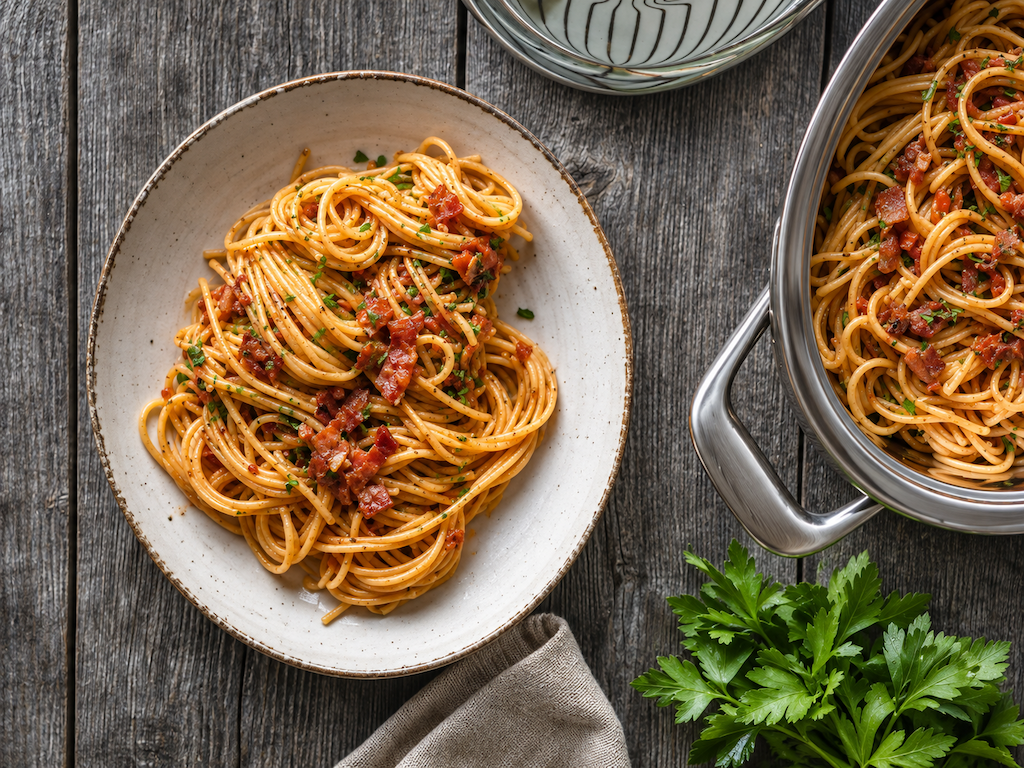
Bucatini all’Amatriciana is one of the best-known pasta dishes associated with central Italy and the Roman culinary tradition, with its name referring back to Amatrice. And few Italian pasta combinations are as recognizable as Amatriciana. Tomato provides the body of the sauce, cured pork brings savory richness, and Pecorino adds the sharp, salty finish that defines the dish. At Mama Florence Cooking School, our version is made with pancetta, garlic, tomato, and aged Pecorino, paired with pasta made from semola flour and eggs. The sauce cooks slowly for at least 30 minutes while the homemade pasta rests, is rolled, and cut. The finished pasta is tossed directly through the tomato and pancetta sauce, loosened with a little cooking water if needed, then served immediately with grated or slivered Pecorino. For another fresh-pasta foundation, our Fresh Egg Tagliatelle explores the same hands-on principles of kneading, resting, rolling, and cutting dough into a different pasta shape.
How to Make Bucatini all’Amatriciana
Begin by making the fresh pasta dough. Combine semola flour with eggs and knead until smooth, soft, elastic, and compact. Cover the dough and allow it to rest for at least 15 minutes. While the dough rests, begin the sauce. Warm extra virgin olive oil with a garlic clove, then add diced pancetta once the garlic becomes golden. When the pancetta begins to brown, remove the garlic and add the tomato. Bring the sauce to a boil, season with salt, then lower the heat, cover, and cook gently for at least 30 minutes. Roll the rested dough through a pasta machine and cut it using the appropriate noodle attachment. Cook the pasta in salted boiling water until done, drain, and toss it directly in the sauce. If needed, loosen the sauce with a small amount of pasta cooking water. Finish with plenty of aged Pecorino.
Mama’s Secret: Finish the pasta directly in the Amatriciana sauce rather than spooning the sauce over it on the plate. A small splash of pasta water can help the tomato, pancetta fat, and pasta come together into a more cohesive coating.
Homemade Pasta Ingredients:
• 14 oz semola flour • 4 eggs • Additional semola, as needed for dusting
Amatriciana Sauce Ingredients:
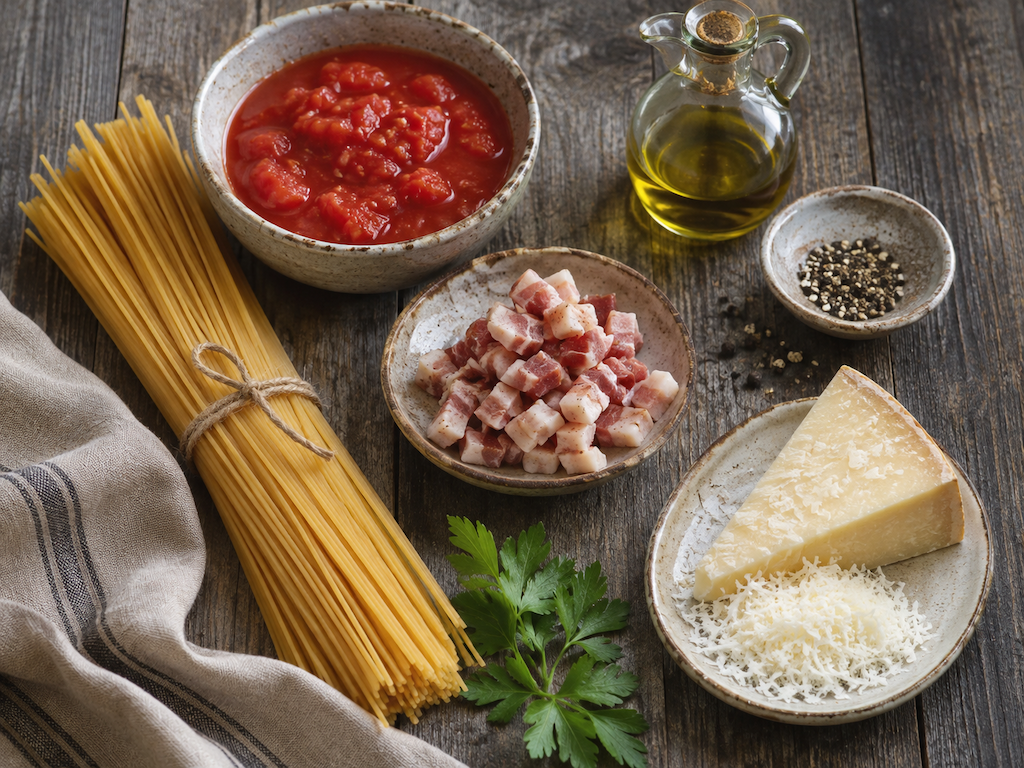
• 7 oz pancetta • 17½ oz canned tomatoes, tomato pulp, or purée • 1 garlic clove • Extra virgin olive oil, as needed • Salt, as needed
To Finish:
• Aged Pecorino, grated or shaved, as needed • Pasta cooking water, as needed
1. Make the Pasta Dough
Place the 14 oz semola flour in a medium bowl.
Add the 4 eggs.
Mix until a dough begins to form.
2. Knead the Dough
Transfer the dough to a lightly floured work surface.
Knead with the palm of your hand until it becomes smooth, soft, elastic, and compact.
The dough should hold its shape when formed into a ball.
3. Rest the Dough
Shape the dough into a ball.
Cover tightly with plastic wrap to preserve its elasticity.
Rest at room temperature for at least 15 minutes.
4. Prepare the Dough for Rolling
Remove the plastic wrap.
Knead briefly and shape the dough into a rectangle approximately the width of your pasta machine.
5. Roll the Pasta
Dust the pasta machine generously with semola.
Pass the dough through the machine.
Continue adjusting the rollers and passing the dough through progressively thinner settings until the desired thickness is reached.
6. Cut the Pasta
Dust the work surface with semola.
Cut the pasta sheets into manageable lengths.
Pass each sheet through the noodle-cutting attachment.
Form the cut pasta loosely into nests.
Place the nests on a wooden board dusted generously with semola while you prepare the rest.
7. Prepare the Pancetta
Cut the 7 oz pancetta into coarse pieces or small cubes.
Set aside.
8. Begin the Sauce
Coat the bottom of a medium saucepan with extra virgin olive oil.
Heat gently.
Add the garlic clove.
Cook until the garlic takes on a golden color.
9. Brown the Pancetta
Add the diced pancetta.
Cook until it begins to brown and release its fat.
Remove the garlic clove from the pan.
10. Add the Tomato
Add the 17½ oz canned tomatoes, tomato pulp, or purée.
Stir to combine with the pancetta and cooking juices.
Bring the sauce to a boil.
11. Slowly Cook the Amatriciana Sauce
Season with salt to taste.
Lower the heat.
Cover the saucepan.
Cook very gently for at least 30 minutes.
The sauce should become concentrated and savory without drying out completely.
12. Cook the Pasta
Bring a large pot of generously salted water to the boil.
Add the fresh pasta.
Cook until done, tasting the pasta to judge the texture.
13. Finish the Pasta in the Sauce
Drain the pasta thoroughly.
Transfer it directly into the saucepan with the Amatriciana sauce.
Toss until evenly coated.
If the pasta seems too dry, add a small amount of reserved pasta cooking water.
14. Add the Pecorino
Divide the pasta among individual serving plates.
Finish with aged Pecorino, either freshly grated or finely shaved.
Serve immediately.
Why Pancetta Works in Our Amatriciana Sauce
Our recipe uses pancetta rather than guanciale. As it cooks, the pancetta renders some of its fat into the pan while developing browned, savory edges. That fat becomes part of the sauce when the tomato is added, giving the finished pasta greater depth without requiring a long ingredient list. Because the cured pork is already salty, taste the sauce before adding too much additional salt.
Why the Garlic Is Removed
The garlic perfumes the olive oil at the beginning of the sauce. Once it becomes golden and the pancetta has started cooking, our method removes it before the tomato goes in. This keeps the garlic as a background aromatic rather than allowing it to dominate the finished sauce.
Why Pecorino Belongs with Amatriciana
Pecorino brings the sharp, salty finish that balances the tomato and rich cured pork. Unlike a softer, milder cheese, aged Pecorino has enough character to remain noticeable against the sauce. Our recipe allows it to be served grated or slivered, so the final texture can be adapted according to preference. If you want to explore another famous Roman combination built around Pecorino, Mama Florence currently offers a dedicated Cacio e Pepe Pasta Cooking Class, alongside its wider pasta program.
Why Pasta Water Helps the Sauce
Starchy pasta cooking water is useful if the finished pasta becomes too dry after being added to the sauce. A small amount loosens the tomato and rendered pancetta fat while helping everything cling more evenly to the pasta. Add it gradually. The goal is not to dilute the Amatriciana, but to help the sauce coat each strand.
Fresh Pasta and Amatriciana
Our supplied recipe makes the pasta from scratch using semola flour and eggs. For another homemade pasta technique, our Fresh Egg Tagliatelle shows how fresh dough can be rolled and cut into traditional ribbons. For filled pasta, our Spinach and Ricotta Tortelli takes the same fundamental skills — kneading, resting, rolling, and handling fresh dough — and applies them to stuffed pasta instead.
The Perfect Bite
The pasta should retain enough texture to stand up to the tomato sauce. The first flavor is savory pancetta, followed by concentrated tomato and the salty sharpness of Pecorino. The garlic should remain subtle, supporting the sauce without becoming the dominant flavor. The best forkful catches pasta evenly coated in tomato sauce with a small piece of browned pancetta and enough Pecorino to bring everything together.
More Italian Pasta Recipes to Explore
If you want to continue with classic sauces, our Italian Meat Ragù explores a completely different tomato-and-meat sauce built around slow cooking rather than cured pork. For a fresh pasta foundation, our Fresh Egg Tagliatelle is a useful recipe for practicing dough, rolling, and machine cutting. Our Handmade Cavatelli with Beef Ragù moves into a hand-shaped pasta designed to catch a heavier sauce. And for another filled-pasta direction, our Potato Tortelli explores a traditional Tuscan potato filling inside fresh pasta.
Learn to Make Italian Pasta in Florence
Fresh pasta technique is at the center of many experiences at Mama Florence Cooking School. Our current Cooking Classes in Florence include a dedicated Pasta Making Cooking Class as well as Cacio e Pepe, gnocchi and fresh pasta, Corzetti, pesto and pasta, and other specialized pasta experiences. The current Mama Florence program also includes a class dedicated to moving from spaghetti to macaroni, exploring different pasta formats and fresh-pasta techniques. For this recipe in particular, the useful skills are the fundamentals: judging dough consistency, rolling it evenly, using the pasta machine confidently, and finishing the cooked pasta directly in its sauce.
Frequently Asked Questions
Q: What is Bucatini all’Amatriciana? A: It is a pasta dish associated with Amatrice and Roman cooking, built around cured pork, tomato, and Pecorino.
Q: Does this Mama Florence Amatriciana use guanciale or pancetta? A: Our supplied recipe uses pancetta.
Q: How much pancetta is used? A: Our recipe uses approximately 7 oz pancetta for 6 servings.
Q: How much tomato is used? A: The recipe uses approximately 17½ oz canned tomato, tomato pulp, or purée.
Q: What cheese goes on Amatriciana? A: Our recipe uses aged Pecorino, served grated or finely shaved.
Q: How long does the Amatriciana sauce cook? A: Cook it gently for at least 30 minutes after adding the tomato.
Q: Do I leave the garlic in the sauce? A: No. Our method removes the garlic after the pancetta begins to brown.
Q: How long should the fresh pasta dough rest? A: Rest it at room temperature for at least 15 minutes.
Q: What flour is used for the pasta? A: Our recipe uses 14 oz semola flour with 4 eggs.
Q: Can I add pasta water to Amatriciana?A: Yes. Our recipe recommends adding a small amount if the pasta is too dry after being tossed with the sauce.
Q: Is this Amatriciana made with fresh pasta? A: Our Mama Florence recipe includes homemade pasta made from semola flour and eggs.
Q: Does the sauce contain onion? A: No. Onion is not included in the supplied recipe.
Disclaimer
Please note that our chefs may adapt recipes according to seasonal ingredient availability and participants’ dietary or allergy requirements. As a result, the ingredients, preparation, or presentation shown in this recipe may vary from what you prepared during your Mama Florence class. In some cases, elements of a dish may also appear as separate recipes — for example, the fresh pasta you prepared may be paired here with a different sauce, while the sauce from your class may appear in another recipe. Please reach out to our team if any confusion arises. Thank you — the Mama Florence Family.
Reviews
4.912 reviews
Not quite what we remember from Tuscany, but very good on its own terms.
Rachel C.
Cardiff, UK · July 2026
I was cooking for people with completely different tastes and this satisfied all of them.
Federica S.
Bologna, Italy · July 2026
My partner does not usually notice the difference between fresh and dried. He noticed.
Jenna P.
Portland, USA · June 2026
I let it rest longer than suggested because I got distracted, and honestly it rolled even better.
Emma L.
Bristol, UK · June 2026
Clear, well ordered, no unnecessary equipment.
Sarah M.
Boston, USA · January 2026
Would recommend to anybody starting out. It is not a showpiece, it is something you will actually cook again on a normal evening. I have made it four times in a month and I have stopped needing the page open. That felt like a bigger achievement than the first attempt did.
Michael R.
Austin, USA · December 2025
Bought a cheap roller after reading this and it changed everything. Should have done it years ago.
Robert H.
Seattle, USA · October 2025
Took me twice the stated time because I am slow, but the result was right.
David K.
Chicago, USA · July 2025
Not a beginner recipe in my opinion, but the instructions are honest about that and the result rewards the effort.
Sophie H.
Edinburgh, UK · May 2025
Cut them by hand with a knife rather than the machine and they were rustic but great. The flour quantity was spot on for my eggs.
Claire B.
Ottawa, Canada · May 2025
One guest asked if I had bought it, which I have decided to take as a compliment.
Markus H.
Cologne, Germany · May 2025
We cannot find the same ingredients at home, so it is an approximation. A very happy one.
Course: First Course / Pasta - Cuisine: Italian; Serves: 4. Prep: approx. 30 min. Rest/Marinate: 30 min. Cook: approx. 15–20 min. Total: approx. 1 hr 15 min.
Course: First Course / Pasta - Cuisine: Italian; Serves: 4. Prep: approx. 10 min. Cook: according to pasta package, plus 2 min. Total: approx. 25–30 min.