Pici all’Aglione: The Story of Tuscany’s Hand-Rolled Pasta and Giant Garlic | Mama Florence Cooking School
What Is Pici all’Aglione?
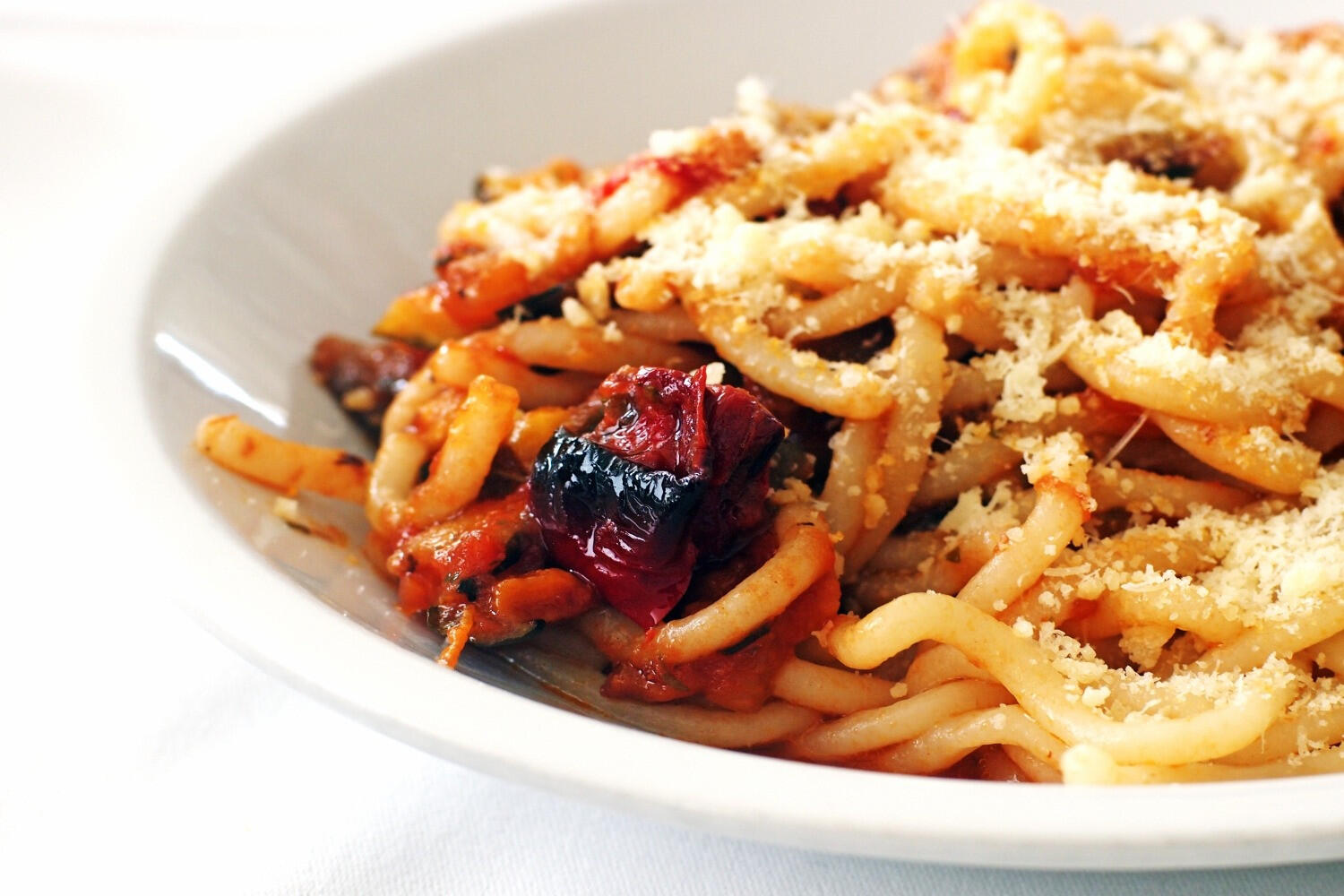
Pici all’Aglione is one of those Tuscan dishes that seems almost romantic to make - and happens to pair perfectly with a date, despite being a garlic dish. This traditional Italian pasta pairs thick strands of Pici pasta, rolled by hand from flour and water, with tomato, olive oil, and Aglione - an enormous, unusually delicate garlic of the Valdichiana. The dish came to life in the countryside of southern Siena, particularly the territory around Chiusi, Montepulciano, and Mount Cetona. While Pici is stretched into long, thick, irregular strands - unmistakably rustic pasta - its counterpart, the Aglione sauce, balances those beautifully chewy strands with a softness that leaves the mouth watering, creating the traditional, authentic Italian pasta recipe known as Pici all’Aglione.
At Mama Florence Cooking School, Pici all’Aglione is a dish we love because both the pasta and the sauce tell you something about the landscape they come from.
And what is Aglione? Its bulbs can grow astonishingly large, but size is not what makes it special. Compared with ordinary garlic, its aroma and flavor are gentler and less invasive - one reason it has acquired affectionate nicknames such as l’aglio del bacio and the garlic of lovers.
It is a useful reminder that in Tuscan cooking, intensity does not always come from adding more. Sometimes it comes from knowing exactly which two ingredients need to speak to one another.
What Is Pici Pasta? Tuscany’s Hand-Rolled, Egg-Free Pasta
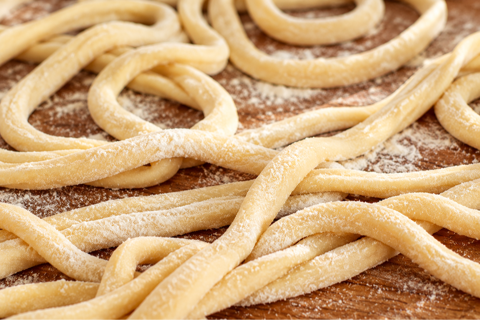
Pici pasta is among Tuscany's most elemental traditional pastas. There are no elaborate folds and no filling hidden inside (making it surprisingly easy to make). This egg-free pasta dough is worked by hand, cut into pieces, and rolled until each piece lengthens into something resembling a very thick, irregular spaghetti.
The technique is known as appiciare, the hand motion from which the name Pici is commonly said to derive. It is less about precision than repetition: press, roll, lengthen, move to the next strand. No two pieces need to be exactly alike.
When we make fresh pasta at Mama Florence Cooking School, pici are a perfect example of why handmade pasta does not need to look perfectly uniform.
That simplicity once made Pici an important food for rural families. Mama Florence's existing guide to authentic Tuscan Pici describes them as a staple of peasant households in the southern province of Siena, served with sauces built from ingredients that were inexpensive, local, and available: garlic and breadcrumbs fried in oil, simple meat sauces, or, around Lake Chiusi, even pike roe.
Today the shape remains deeply associated with southern Tuscany. In the Val d’Orcia, Pici - or pinci around Montalcino - still appears alongside meat ragù, breadcrumbs, and, most famously, Aglione.
The recipe is humble. The technique less so, not when every strand that falls across your plate carries the evidence that somebody stood at the table and rolled it.
Aglione vs Garlic: What Is Elephant Garlic?
Aglione della Valdichiana is not simply giant garlic. It is a local allium traditionally grown in Valdichiana, the broad agricultural valley extending through parts of Siena, Arezzo, and toward Umbria. Its cloves are dramatically larger than common garlic, and individual bulbs can reach several hundred grams, earning it the affectionate nickname elephant garlic.
But what is elephant garlic in the context of Aglione, beyond its enormous size? More important is what does it taste like? Aglione has a much more delicate aroma than traditional garlic. Producers in the Valdichiana prize it for this very reason: it is sweeter, softer, and far less aggressive on the palate. And that difference changes how the Aglione sauce comes to life: Pici all’Aglione is not tomato sauce overwhelmed by raw garlic. The Aglione is cooked slowly in olive oil until it softens and begins to melt, then tomato is added until the two slowly cook down, becoming a sweet, creamy, and remarkably gentle traditional Tuscan sauce.
With surprisingly little garlic residue, for all garlic lovers, this Tuscan pasta recipe makes the perfect dish for a romantic night out.
Cucina Povera: Pici all’Aglione and the Tuscan Tradition
Pici all’Aglione belongs naturally to the wider tradition of Tuscan cucina povera: cooking shaped by seasonality, economy, and the ingredients a landscape could provide. Pici and Aglione are both deeply rooted in the Valdichiana and surrounding Sienese countryside, where the dish has survived as part of the region’s culinary identity. And the tradition survives quite literally. In Celle sul Rigo, the Sagra dei Pici has gathered the community to appiciare - to make Pici pasta by hand - since 1969. The endearing elephant garlic, Aglione, itself came remarkably close to disappearing, and is now among the local varieties protected through its agrobiodiversity system.
Pici all’Aglione becomes a particularly lovely example of what cucina povera can preserve. A short list of ingredients becomes a recipe; a crop nearly lost becomes something worth protecting; and flour and water become Pici because somebody still takes the time to roll every strand.
Sometimes preserving history can be as small as the dish placed down upon a table.
Learn How to Make Pici at Mama Florence Cooking School
If Pici all’Aglione has made you want to put your own hands into the dough, we'd love to welcome you into our cooking school in Florence.
Join our Pasta Making Cooking Class to learn how fresh pasta comes together from scratch, and practice the shaping techniques that turn a simple dough into regional Italian pasta, including the hand-rolled tradition behind Pici.
Or join us for our Cooking Class + Chianti Wine Tour which carries you beyond the kitchen into the Tuscan countryside, where food, wine, agriculture, and landscape become part of the same experience.
Because the best Italian recipes are more than instructions on a page. They are techniques repeated until they become tradition, ingredients kept alive because someone continues to grow them, and meals that make a place easier to understand.
We'd be honored to share that tradition with you.