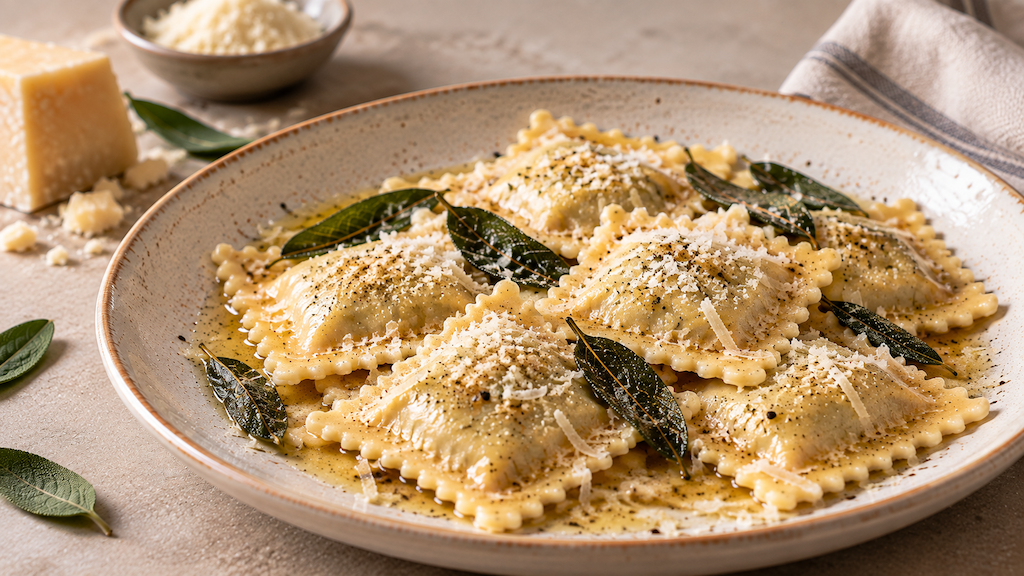
Fresh filled pasta takes a little patience at the best of times, and gluten-free dough asks you to pay even closer attention to how it feels beneath your hands. At Mama Florence Cooking School, this ravioli dough combines gluten-free flour with buckwheat flour, eggs, olive oil, water, and xanthan gum. The filling stays classic: ricotta, spinach, Parmigiano, nutmeg, salt, and pepper. Once shaped, the ravioli are finished in butter and sage with a little pasta water and Parmigiano - simple enough to let both the filling and the dough come through.
What Makes This Ravioli Gluten-Free?
Traditional fresh ravioli dough is usually made with wheat flour, but this recipe replaces it with a combination of gluten-free flour and buckwheat flour. Because gluten normally gives pasta dough much of its elasticity and strength, this version also uses xanthan gum to help hold the dough together. The finished dough behaves differently from wheat pasta and can be more crumbly, which is why the recipe recommends working with it in small 50 g portions rather than trying to roll the whole batch at once.
How to Make Gluten-Free Ravioli Dough
Gluten-Free Pasta Dough Ingredients
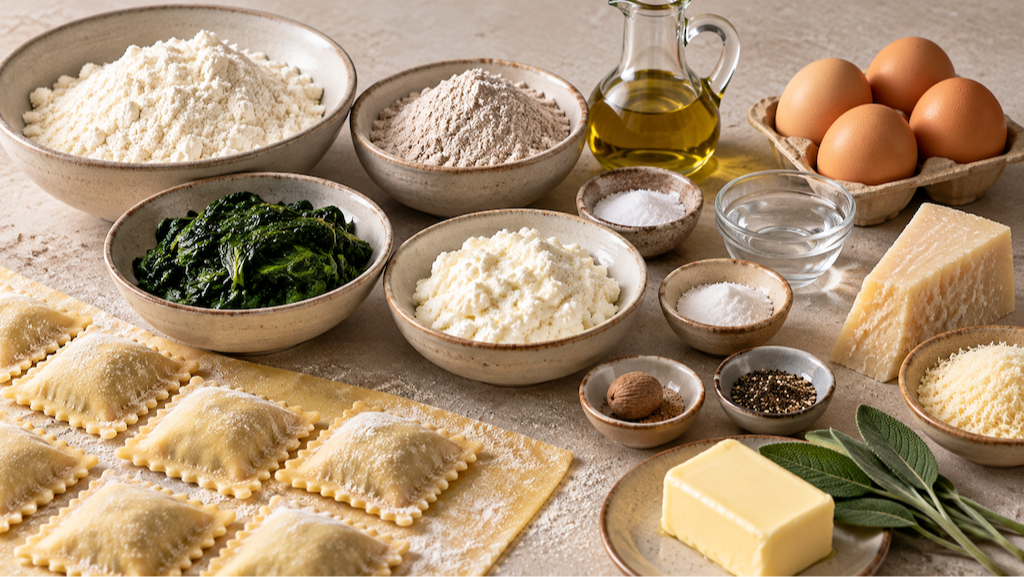
• 340 gr gluten-free flour • 60 gr buckwheat flour • 4 tbsp olive oil • 4 medium eggs • 1 pinch salt • 4 tbsp water • 1 tsp xanthan gum
Mama’s Secret: Work with the gluten-free dough in small pieces. The original recipe recommends dividing it into portions of about 50 g each because the dough tends to be more crumbly than traditional wheat pasta. Rolling one piece at a time makes it easier to keep the rest intact while achieving a thin, even sheet.
1. Make the Dough
Combine the gluten-free flour, buckwheat flour, xanthan gum, and salt in a bowl.
Add the eggs, olive oil, and water.
Mix with a fork for approximately 1 minute.
Continue working the dough with your hands in the bowl for another 2 minutes, making it as uniform as possible.
Transfer to a pastry board and continue working for another couple of minutes.
How to Make Ricotta and Spinach Filling
Ricotta and Spinach Ingredients
• 250 gr ricotta, preferably sheep’s milk ricotta • 200 gr boiled spinach, very well drained • 30 gr grated Parmigiano • salt, to taste • black pepper, to taste • nutmeg, to taste
1. Make the Ricotta and Spinach Filling
Rinse the fresh spinach leaves and boil them in salted water.
Drain thoroughly, then squeeze out as much excess liquid as possible.
Finely chop the spinach.
Add the ricotta, spinach, grated Parmigiano, salt, black pepper, and nutmeg to a bowl.
Mix until the filling is firm and evenly combined.
There should be no excess liquid left in the mixture.
How to Make the Glutten-Free Ravioli
1. Rollout the Gluten-Free Dough
Divide the dough into portions of approximately 50 gr each.
Work with one portion at a time.
Using a rolling pin, roll the dough until it is less than 1 mm thick.
Because gluten-free dough can be crumbly, handle it gently as you roll.
2. Fill and Shape the Ravioli
Cut round disks from the rolled dough using a glass or pasta mold.
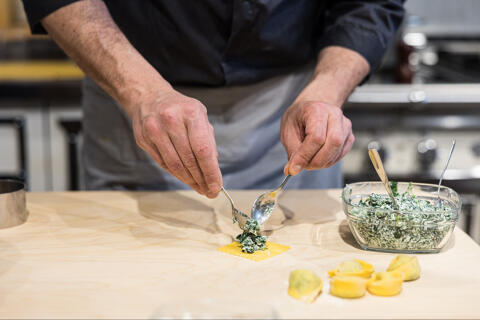
Place 1 teaspoon of filling in the center of one disk.
Lay a second disk over the top.
Press gently around the filling to push out trapped air.
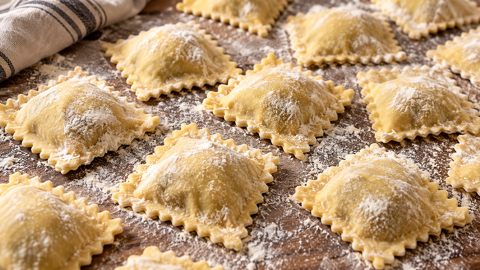
Seal the edges first with your fingers, then reinforce the seal with the tines of a fork.
Note from Mama: Remove all the air from the Ravioli. Trapped air can expand as ravioli cook. Pressing gently around the filling before sealing reduces the chance of the pasta opening in the water. With gluten-free ravioli, a secure seal is especially useful because the dough does not have the same elasticity as a traditional wheat-based pasta dough.
3. Cook the Ravioli
Bring a large pot of salted water to the boil.
Cook the ravioli for 6 minutes.
Before draining, reserve a little pasta cooking water.
How to Make Butter and Sage Sauce
Sauce Ingredients
• 80 gr butter • 12 medium sage leaves • grated Parmigiano, as needed • salt, to taste • pepper, to taste
1. Make the Butter and Sage Sauce
Melt the butter in a medium sauté pan.
Add the sage leaves and a little reserved pasta water.
Cook for a few minutes, until the sauce begins to thicken but is not overly dense.
Plate the Pasta
Add the cooked ravioli to the butter and sage sauce.
Toss gently so the pasta and sauce come together.
Remove the pan from the heat.
Add grated Parmigiano and stir until the sauce becomes creamy.
Serve hot.
Why Butter and Sage Work with Ricotta and Spinach Ravioli
Ricotta and spinach make a relatively delicate filling. Butter gives the pasta richness without covering that filling, while sage adds a warm herbal note that works naturally with spinach and nutmeg. The pasta water helps loosen the butter into a light sauce, and Parmigiano finishes everything with salt and savoriness. It is a classic kind of pairing because the sauce supports the ravioli rather than competing with them.
Gluten-Free Ravioli vs Traditional Fresh Ravioli
The biggest difference is the dough. Traditional fresh ravioli usually relies on gluten for elasticity, making the pasta easier to stretch and seal. This version uses gluten-free flour, buckwheat flour, and xanthan gum, so the dough is naturally more fragile and crumbly. That is why the method changes slightly: smaller portions, gentle rolling, and careful sealing become especially important. The goal is not to make gluten-free dough behave exactly like wheat dough, but to work with the texture it actually has.
The Perfect Bite
The pasta should be thin enough to keep the ravioli delicate, but strong enough to hold the filling intact. Inside, the ricotta should stay soft and creamy while the spinach, nutmeg, and Parmigiano give it more depth. The butter and sage should coat the ravioli lightly, with just enough Parmigiano at the end to tie the sauce back to the filling.
More Handmade Pasta to Make
If you want to compare this gluten-free dough with traditional fresh pasta, our Fresh Egg Tagliatelle uses all-purpose flour, semola, and eggs to make thin ribbons. For another filled pasta, try our Tortelli di Patate, filled with potato, Parmigiano, butter, garlic, parsley, and nutmeg. And if butter and sage is the part calling your name, our Tortelli di Patate with Butter and Sage gives that pairing a distinctly Tuscan potato-filled direction.
Learn Gluten-Free Pasta with Mama Florence
Gluten-free pasta is one of those things that becomes much easier once you can feel what the dough is supposed to be doing.
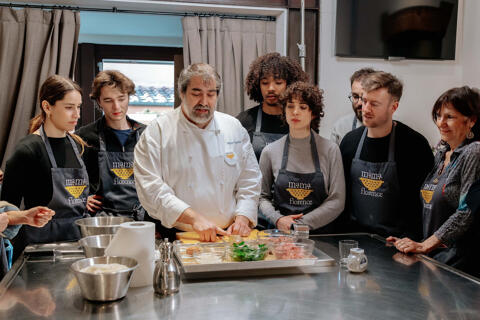
In our Gluten-Free Cooking Class at Mama Florence Cooking School, you can work alongside our chefs and learn how to handle doughs that behave differently from traditional wheat pasta.
Gluten-Free Ravioli FAQ
Q: What flour is used for gluten-free ravioli? A: This Mama Florence recipe uses 340 g gluten-free flour and 60 g buckwheat flour.
Q: Why does gluten-free pasta dough use xanthan gum? A: This recipe uses 1 teaspoon xanthan gum to help give structure to a dough that does not contain gluten.
Q: What is the ravioli filling made from? A: The filling uses 250 g ricotta, 200 g boiled and thoroughly drained spinach, 30 g Parmigiano, salt, black pepper, and nutmeg.
Q: How thin should gluten-free ravioli dough be? A: Roll each portion until the dough is less than 1 mm thick.
Q: How long do gluten-free ravioli cook? A: Cook them in salted boiling water for 6 minutes.
Q: Why should I divide gluten-free dough into small portions? A: The dough tends to be more crumbly than wheat-based pasta, so the source recipe recommends working with portions of around 50 g at a time.
Q: What sauce goes with ricotta and spinach ravioli? A: This recipe finishes the ravioli with 80 g butter, 12 sage leaves, pasta cooking water, and grated Parmigiano.
Q: Is this recipe vegetarian? A: Yes. It contains eggs and dairy but no meat or fish.
Disclaimer
Please note that our chefs may adapt recipes according to seasonal ingredient availability and participants’ dietary or allergy requirements. As a result, the ingredients, preparation, or presentation shown in this recipe may vary from what you prepared during your Mama Florence class. In some cases, elements of a dish may also appear as separate recipes — for example, the fresh pasta you prepared may be paired here with a different sauce, while the sauce from your class may appear in another recipe. Please reach out to our team if any confusion arises. Thank you — the Mama Florence Family.
Reviews
4.811 reviews
Made it twice in a week to get it right. The first time I misread one step and it showed. The second time I set a timer for the part I always forget. It was worth being stubborn about.
Marc L.
Montreal, Canada · April 2026
Slightly more fragile than expected, so I worked in smaller pieces and it was fine.
Nicole F.
Charlotte, USA · January 2026
Made it for four generations at the same table and there was nothing left. That does not happen often.
Kate D.
Melbourne, Australia · January 2026
I doubled it so we would have leftovers and there were none. Lesson learned.
Laura B.
Denver, USA · January 2026
One thing that helped me: start with the slowest step and organise everything else around it.
Lena F.
Stuttgart, Germany · December 2025
Bought a cheap roller after reading this and it changed everything. Should have done it years ago.
Ryan M.
Vancouver, Canada · September 2025
I have made this three times now. Each time it gets faster and each time it beats the packet version by a distance.
Anna W.
Berlin, Germany · August 2025
Followed it exactly and it worked. Not much else to say.
Eline K.
Rotterdam, Netherlands · July 2025
My partner does not usually notice the difference between fresh and dried. He noticed.
Oliver N.
Brighton, UK · May 2025
I cook everything in this house gluten free and this is now in the regular rotation.
Daniel O.
Brooklyn, USA · May 2025
Bought one piece of equipment I did not own and it was worth it. Everything else I already had.