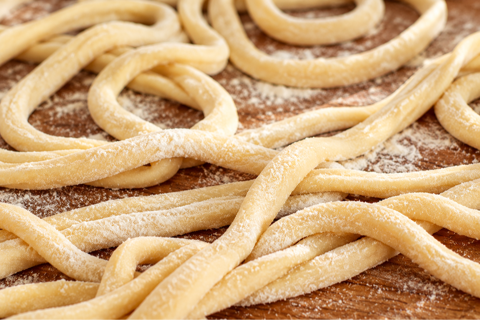
Corzetti al Pesto
What Is Corzetti? Liguria’s Traditional Stamped Pasta
Corzetti is a traditional stamped pasta from Varese Ligure, Italy. Once embossed with the coats of arms of noble and merchant families during the Middle Ages, these delicately patterned discs became quiet expressions of identity, prosperity, and belonging. Today, Corzetti remains one of Italy's most distinctive handmade pastas, traditionally served with salsa di noci (walnut sauce), pesto alla Genovese, marjoram and pine nut sauce, or burro e maggiorana (butter and fresh marjoram). More than a regional specialty, it preserves a culinary tradition that continues to bring generations together around the table. This distinctive Ligurian pasta is also known as Corzetti stampati, a form of handmade Italian pasta shaped and decorated with carved wooden tools.
Some Italian recipes are remembered for their flavor. Others are remembered for the stories they carry. Corzetti stampati - the stamped Corzetti pasta of Liguria - belongs to the second tradition. As a traditional Ligurian pasta, its identity is inseparable from the impressions left by a Corzetti pasta stamp.
At first glance, these beautifully stamped discs seem little more than an exercise in artigianato del legno - the centuries-old craft of Italian woodcarving. Yet behind every carefully carved impression lies a question that reaches far beyond the kitchen.
Why Is Corzetti Stamped?
The answer begins with geography. Liguria is a thin ribbon of coast pinned between the Mediterranean and steep mountain ranges. With little fertile farmland and no vast estates on which a landed aristocracy could flourish as it did elsewhere in Italy, wealth found another route: the sea. Prosperity came through shipping and trade, and with it emerged powerful merchant families whose influence rested not on inherited land, but on reputation. That maritime history helps explain why this stamped pasta developed such a distinctive visual language in Liguria.
As their fortunes grew, heraldic symbols spread across the Ligurian coast. Coats of arms appeared on seals, banners, documents, and household objects, becoming visual signatures of a family's identity, prosperity, and standing. Even the plate placed before a guest at the table could quietly declare: this is who we are.
The name Corzetti seems to preserve the memory of that world. Scholars believe it derives either from croxetto - from the Latin crux, meaning “small cross”- or from the corzetto, a medieval Genoese coin. Introduced by the Republic of Genoa in the twelfth century, its earliest coins bore the city's distinctive heraldic cross, and the embossed pasta came to resemble these small pieces of currency pressed into dough: edible coins that carried not monetary value, but family heritage. The competing origins of the name are part of what makes the history of Corzetti pasta so compelling.
But unlike a carving in stone or an impression in wax, the mark left on Corzetti was always meant to disappear.
Each seal was pressed carefully into the dough by hand, carried to the table, shared among family and friends, and eventually vanished beneath butter, walnut sauce, or fragrant pesto alla Genovese. It was never intended to survive behind glass or endure as an heirloom. Its purpose was fulfilled in the act of being shared. The patterned surface also gave this handmade pasta a practical purpose: each impression created texture for delicate sauces to cling to.
Perhaps that is the quiet genius of Corzetti. The crest announced a family's identity, but it was the table that gave it meaning. That idea feels just as true today.
Corzetti Stamps: The Medieval Origins of this Ligurian Pasta
Across Italy, the table has always been more than a place to eat. It is where history is carried forward through conversation, generosity, and shared ritual. Around it, recipes become memories, strangers become guests, and traditions survive not because they are protected, but because they are passed from one pair of hands to another. And with each bite of those beautiful embossed coins, Corzetti begins to share its own identity, just as it had once shared the Ligurian merchants.
This may be the true Ligurian legacy.
While the noble crests that once adorned Corzetti have largely disappeared, the ritual remains. The pasta belongs to Liguria, but the Corzetti stamps themselves tell a quieter story. For generations, many were carved not in Liguria but by Florentine woodworkers, whose craft traveled the short road between the two regions until a distinctly Ligurian tradition became a shared one. These Corzetti stamps for pasta connect Ligurian food tradition with a long history of Florentine craftsmanship.
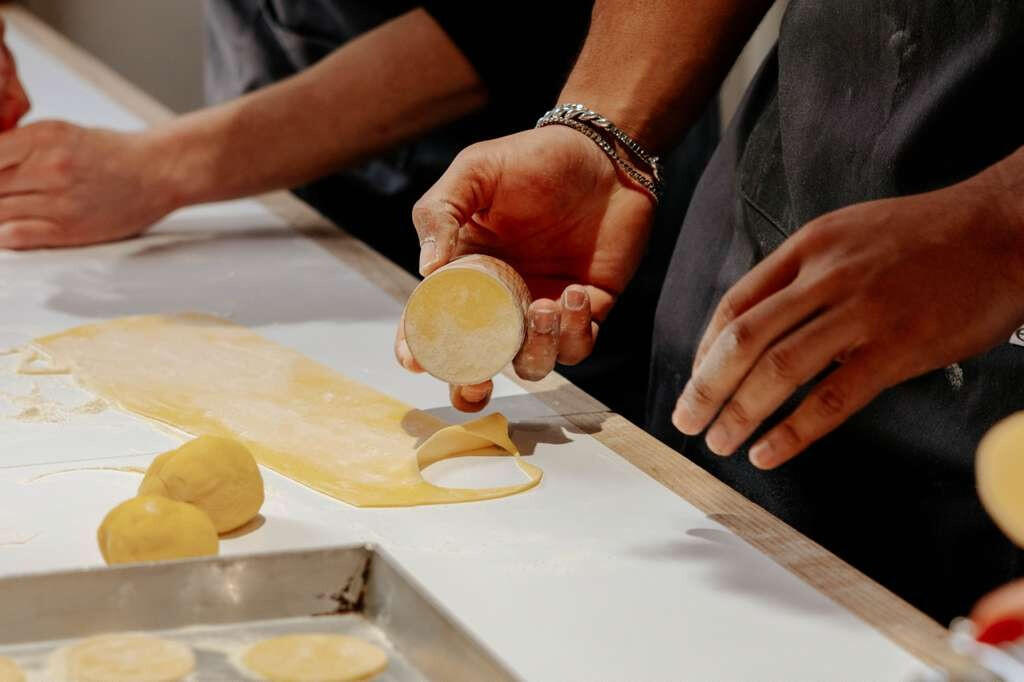
Traditionally fashioned from pear, apple, maple, or faggio (Italian beech), these wooden stamps have long been carved with flowers, delicate geometric patterns, and regional motifs, or, more rarely, the distinctive corzetti della Val Polcevera, shaped in the endless figure-eight spiral. Today, only a handful of artisans continue to carve them entirely by hand. Among them is Filippo Romagnoli, a fourth-generation Florentine artisan and designer who reinterprets Tuscan and Italian culinary traditions through handcrafted objects rooted in local culture, celebrating the idea that everyday kitchen tools can carry history, symbolism, and artistry. Each stamp bears the subtle marks of the hand that made it, preserving a lineage that machine-pressed copies cannot reproduce. A traditional Corzetti stamp is both a cutting and embossing tool, turning simple fresh dough into one of Italy’s most recognizable handmade pasta shapes.
As commercial production has steadily replaced these handcrafted Corzetti pasta stampswith inexpensive plastic versions stamped with pixelated designs that share little genealogy with the tradition that inspired them, the surviving makers have become custodians of something far greater than a kitchen utensil. They preserve a craft whose value lies not only in the object itself, but in the generations of hands that have shaped it. The difference between an artisan Corzetti pasta stamp and a mass-produced version is visible in the depth, individuality, and character of the carved design.
It is one of the reasons Corzetti has become one of our favorite traditions to teach at Mama Florence's Cooking School. Every time guests press a Corzetti stamp into the dough, they repeat a gesture that has traveled from medieval workshops to family kitchens for centuries. For a brief moment, the distance between the merchants who once displayed these embossed coins upon their tables and the travelers who admire them today quietly disappears. For anyone wondering how to make Corzetti, stamping is not decoration added at the end; it is the technique that gives the pasta its identity.
How Do You Make Traditional Ligurian Corzetti Pasta
At Mama Florence's Cooking School, Corzetti is made in two distinct ways: a traditional dough with egg yolks and white wine, and our modern preparation with semola, spelt, and water. The full quantities and method for both are available in our Corzetti al Pesto recipe.
Long before tomatoes transformed Italian cooking, Corzetti belonged to the world of cucina in bianco—the rich tradition of “white” cooking, where sauces drew their flavor not from tomatoes but from herbs, nuts, butter, olive oil, woodland mushrooms, and aged cheeses. Although tomatoes first arrived in Europe during the sixteenth century, they would not become a staple of Italian cuisine for generations. That makes Corzetti an especially revealing example of traditional Ligurian pasta and the sauces that defined the region before tomato became dominant.
Its delicate embossed surface was designed to cradle light, fragrant sauces rather than overwhelm them. Traditionally, this Ligurian pasta is served with salsa di noci (Liguria's celebrated walnut sauce), pesto alla Genovese - the classic Ligurian pesto pasta pairing - burro e maggiorana (butter and fresh marjoram), or marjoram and pine nut sauce. In the cooler months, it is equally at home with gently sautéed porcini or other wild mushrooms, whose earthy flavors reflect the forests that rise beyond Liguria's narrow coastline. These are not simply sauces served beside the pasta; they are part of the traditional vocabulary of Corzetti pasta recipes in Liguria.
At Mama Florence’s Cooking School, pesto remains one of our favorite pairings to teach. Fresh basil, good olive oil, Parmigiano Reggiano, Pecorino, almonds, pine nuts, garlic, and a touch of sea salt create a sauce that settles beautifully into every carved impression. It is a simple pairing, but one that celebrates Liguria in every bite while giving students the chance to learn the traditional techniques behind both the pasta and its sauce. In other words, this is pasta with pesto designed for the sauce: the stamped surface catches the basil, cheese, nuts, and olive oil rather than letting them slide away.
H3: If you'd like to learn how to make authentic pesto from scratch, it's a tradition we teach in our Pesto Making Cooking Class, where every ingredient is prepared with respect to its tradition before being served with fresh handmade pasta. It is also an approachable way to understand a classic Ligurian pesto pasta pairing through technique rather than a generic pesto pasta recipe.
Learn How to Make Corzetti Pasta at Mama Florence's Cooking School
Learning how to make Corzetti pasta is about more than rolling fresh pasta dough. The character of this handmade Italian pasta comes from the pressure, rhythm, and handling of the Corzetti stamp, where every impression turns a simple sheet of pasta into something unmistakably Ligurian.
Join one of our handmade Pasta Making Cooking Classes to learn traditional handmade pasta techniques, or discover the flavors of Liguria in our Pesto & Pasta Cooking Class, where fresh pasta meets pesto alla Genovese around the Mama Florence table.
Because the best Italian recipes are more than instructions on a page. They are traditions passed from one pair of hands to another, one meal to the next - and we'd be honored to share this one with you.