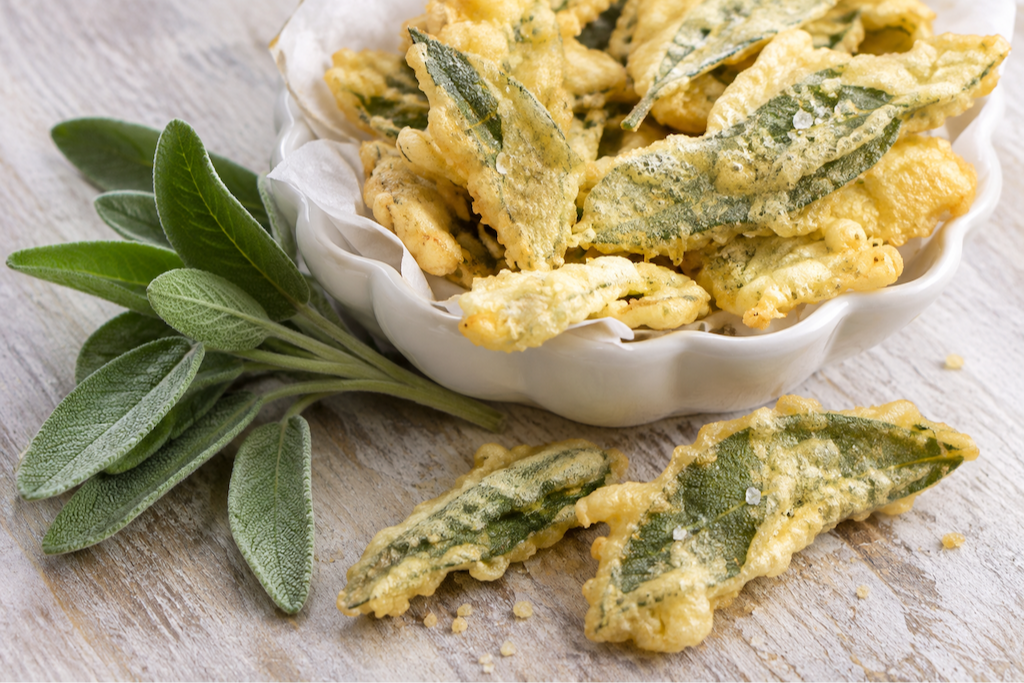
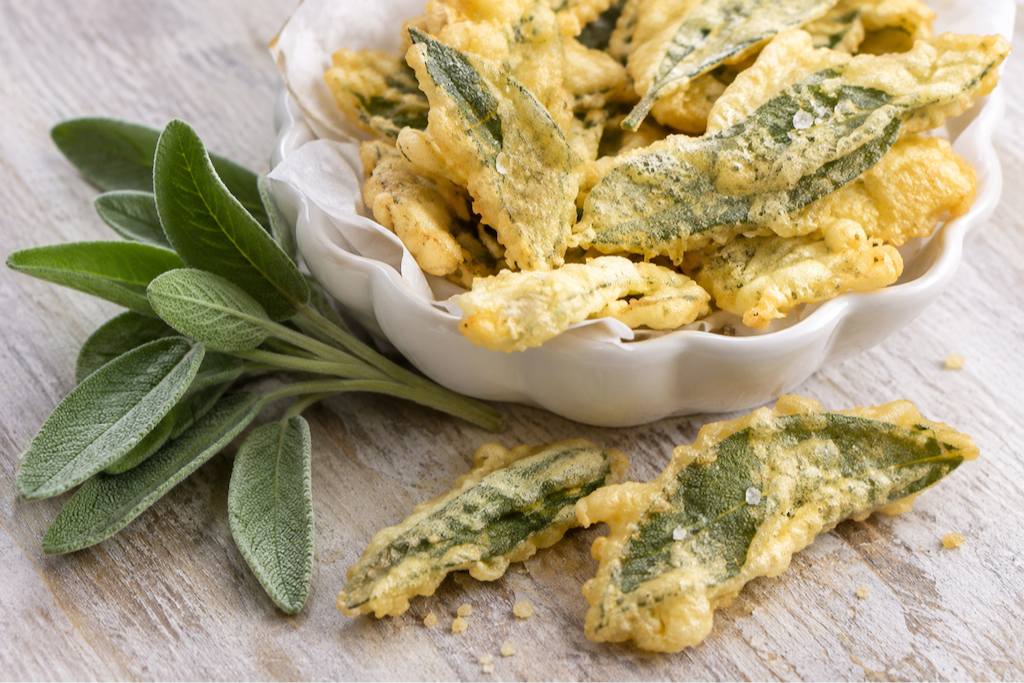
Fresh sage has a strong aroma on its own, but frying changes both its texture and flavor. At Mama Florence Cooking School, our sage leaves are coated very lightly in flour, then fried in extra virgin olive oil for only about 30 seconds per batch until crisp. The finished leaves are served immediately with a simple dipping sauce of extra virgin olive oil, garlic, lemon juice, and salt. They work as an aperitivo snack, a delicate garnish for pasta or risotto, or a small appetizer on their own. If you want to explore the ingredient behind the frying oil itself, our Private Italian Olive Oil Experience in Florencefocuses specifically on tasting, quality, and culinary uses of extra virgin olive oil.
How to Make Crispy Fried Sage Leaves
Start by heating enough extra virgin olive oil in a sturdy skillet for the sage leaves to float and fry evenly. While the oil heats, finely chop the garlic and mix it with extra virgin olive oil, fresh lemon juice, and a little salt for the dipping sauce. Lightly coat the fresh sage leaves with flour, shaking away any excess. Fry them in batches for approximately 30 seconds, until crisp. Drain on paper towels, season lightly with salt while still hot, and serve immediately with the garlic-lemon dipping sauce.
Mama’s Secret: Use only a light dusting of flour. Too much flour creates a heavy coating and hides the sage instead of letting the leaf itself stay crisp and aromatic.
Fried Sage Leaves Ingredients:
• 40 fresh sage leaves • ¾ cup + 1 tablespoon all-purpose flour • Extra virgin olive oil, as needed for frying • Salt, as needed
Garlic-Lemon Dipping Sauce Ingredients:
• 1 garlic clove • 1 lemon • Extra virgin olive oil, as needed • Salt, as needed
1. Make the Dipping Sauce
Peel and finely mince the garlic.
Combine it in a small bowl with extra virgin olive oil, a squeeze of fresh lemon juice, and salt to taste.
Set aside while you fry the sage.
2. Heat the Oil
Pour a generous amount of extra virgin olive oil into a sturdy skillet.
Heat over medium heat.
Use enough oil for the sage leaves to float rather than sit flat against the bottom of the pan.
3. Flour the Sage
Lightly toss the 40 sage leaves in the ¾ cup + 1 tablespoon flour.
Shake off the excess so each leaf has only a thin coating.
4. Fry Until Crisp
Working in batches, carefully lower the sage leaves into the hot oil.
Fry for approximately 30 seconds per batch, until crisp.
Remove with a slotted spoon and drain on paper towels.
Season lightly with salt while still hot.
5. Serve Immediately
Arrange the fried sage leaves on a platter.
Serve with the garlic-lemon dipping sauce while the leaves are still hot and crisp.
Why Sage Works So Well Fried
Sage has a robust herbal flavor that stands up well to hot oil. Frying changes the leaf from soft and slightly fuzzy to thin and crisp, while concentrating its aroma. Because the leaves cook so quickly, the goal is not deep browning. They should remain delicate rather than turning hard or bitter.
Why the Flour Coating Should Stay Light
The flour is there to help create a crisp surface. It should not become a thick crust. Shaking off the excess means the sage remains the dominant ingredient rather than disappearing inside fried dough. That is especially important with such a small, fragile leaf.
Why Extra Virgin Olive Oil Works Here
Our source specifically uses extra virgin olive oil for frying and for the dipping sauce. The oil therefore becomes part of the flavor of the finished appetizer rather than simply acting as a cooking medium. If you want to explore how different olive oils taste and how quality affects cooking, Mama Florence’s Private Italian Olive Oil Experience includes guided tasting and culinary uses of EVOO.
Why Lemon and Garlic Belong in the Dip
The fried sage itself is rich and aromatic. Fresh lemon brings acidity, while garlic gives the dipping sauce a sharper savory edge. Using the same extra virgin olive oil in the dip ties it back to the fried leaves. The sauce should complement the sage rather than overwhelm it.
How to Serve Fried Sage Leaves
These are best served immediately after frying. They can work as a stand-alone aperitivo snack or as a crisp garnish for pasta and risotto. For a classic use of sage with pasta, our Potato Tortelli with Butter and Sage pairs fresh filled pasta with one of sage’s most traditional Italian partners: butter. Our Spinach and Ricotta Tortelli also uses a butter-and-sage finish, showing how differently the herb behaves when gently infused rather than fried.
The Perfect Bite
The sage leaf should be thin, brittle, and crisp. The flour coating should be barely noticeable. Salt sharpens the herbal flavor, while the lemon-and-garlic dip brings acidity and richness. The best bite is eaten immediately, before the leaf has time to soften.
More Tuscan Recipes to Explore
For another recipe where sage plays an important role, our Potato Tortelli with Butter and Sage pairs the herb with butter and fresh filled pasta. Our Spinach and Ricotta Tortelli uses sage in another classic fresh-pasta preparation. For a rustic Tuscan vegetable dish, our Fagioli all’Uccelletto combines cannellini beans with tomato, garlic, sage, and extra virgin olive oil.
Learn Tuscan Cooking in Florence
Simple recipes like fried sage make technique especially visible. The oil temperature, amount of flour, frying time, and timing of service all affect the final texture. At Mama Florence Cooking School, our current Cooking Classes in Florence include Tuscan traditional and vegetarian cooking alongside fresh pasta and other regional experiences. For a deeper focus on olive oil, our Private Italian Olive Oil Experience explores production, tasting, quality, storage, and culinary uses of EVOO.
Frequently Asked Questions
Q: How many sage leaves do I need? A: Our recipe uses 40 fresh sage leaves for 4 servings.
Q: How much flour is used? A: The recipe uses approximately ¾ cup + 1 tablespoon all-purpose flour.
Q: How long do sage leaves take to fry? A: Approximately 30 seconds per batch.
Q: What oil does the recipe use? A: Our source specifically calls for extra virgin olive oil.
Q: Do I need to batter the sage leaves? A: No. They are only lightly coated with flour.
Q: What is the dipping sauce made from? A: Extra virgin olive oil, minced garlic, fresh lemon juice, and salt.
Q: Can I serve fried sage leaves as a garnish? A: Yes. The source suggests serving them as an aperitivo snack or using them as a garnish for pasta or risotto.
Q: Should I serve them hot? A: Yes. Serve immediately after frying for maximum crispness.
Disclaimer
Please note that our chefs may adapt recipes according to seasonal ingredient availability and participants’ dietary or allergy requirements. As a result, the ingredients, preparation, or presentation shown in this recipe may vary from what you prepared during your Mama Florence class. In some cases, elements of a dish may also appear as separate recipes. Please reach out to our team if any confusion arises. Thank you - the Mama Florence Family
Reviews
4.814 reviews
Made it once with the cheapest version of everything and once with the best I could find. Same method, noticeably different result. Worth spending on the one or two things that carry the flavour.
Jenna P.
Portland, USA · July 2026
My partner cooked it while I was working late and it came out well with no experience at all. That says something about the instructions.
Eline K.
Rotterdam, Netherlands · July 2026
Two teenagers and no complaints, which I consider a small miracle.
Claire B.
Ottawa, Canada · July 2026
Reading through it took me straight back to a small table on a warm evening.
James W.
Manchester, UK · June 2026
The instructions are written by somebody who has actually stood in a kitchen. The order of operations makes sense and nothing is left to be guessed.
Christina V.
San Diego, USA · May 2026
Made it at Christmas and it has earned a permanent place.
Maria C.
Lisbon, Portugal · March 2026
Worked well as part of a larger spread, and it needs nothing complicated alongside it.
Daniel O.
Brooklyn, USA · March 2026
My photographs of the holiday are worse than my memory of this dish.
Emma L.
Bristol, UK · March 2026
Clear, well ordered, no unnecessary equipment.
Julia K.
Hamburg, Germany · February 2026
My mother in law, who has opinions, approved. High praise in this house.
Marc L.
Montreal, Canada · December 2025
I left one ingredient out entirely because of an allergy in the house. Slightly missed, nothing ruined.
Luca B.
Turin, Italy · December 2025
Good for guests because it is forgiving about timing. Nothing collapses if people are late.
Rachel C.
Cardiff, UK · November 2025
I like that the quantities are by weight. Cups are the enemy of consistency.
Sanne V.
Utrecht, Netherlands · November 2025
Turns out you can make this for twelve in a domestic kitchen if you plan the space properly.